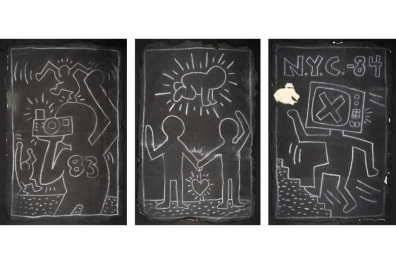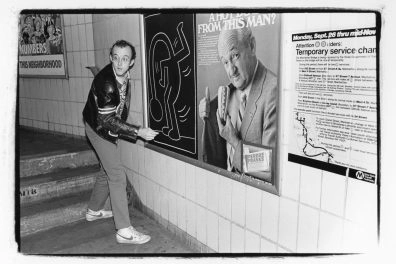
These works were not preparatory studies. They were immediate. Intentional. Radically public. Haring called the subway his “laboratory,” a space where he could test ideas in real time, directly with the people. He wasn’t just drawing. He was connecting.
In the noise and motion of the underground, Haring created stillness. Symbols like the radiant baby, the barking dog, and the crawling figures weren’t graffiti for graffiti’s sake. They were messages anyone could read – regardless of language, background, or destination.
Voice of the Street invites you to see these drawings not just as art, but as acts. They are protests made of joy, warnings made of rhythm, and fleeting moments of care in a city built to move on. These images live on – not just because they were preserved, but because they were shared.
He didn’t wait for permission. He made contact. Then disappeared.
Haring drew to reach people. Not some people. All people.
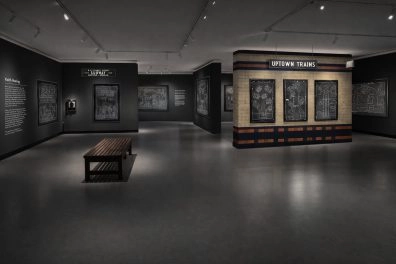
What defines the exhibition
The Underground as Stage
Haring used the subway not just as a space but as a stage, for movement, confrontation, and visibility. He knew he had seconds to spark a reaction. The city became his audience.
Universal Language
Haring’s symbols weren’t just aesthetic. They were communicative. Barking dogs, radiant babies, crawling figures – simple forms carrying complex truths.
Art Without Permission
These drawings weren’t commissioned or protected. But some did survive – and they survive with power. They were acts of belief, in art as action, not possession.
Haring’s Style: Speed and Intuition
Subway drawings had no time for hesitation. Haring relied on muscle memory, improvisation, and deep internal clarity.
Silent Protest, Joyful Resistance
1980s New York was loud with fear, control, and contradiction: the AIDS crisis was escalating, Reagan-era politics clamped down on visibility, and street culture exploded in color and sound. Haring met this moment with silent protest, and radiant joy.
These works weren’t just interruptions, they were invitations.
“If I only made art for galleries, I would probably be frustrated all the time.”
— Keith Haring
What does it mean to live through art?
Keith Haring’s life and work are inseparable. Born in 1958 in Pennsylvania, Haring moved to New York at a moment when the city became a place of artistic experimentation. Drawing from graffiti, pop culture, and mass communication, he developed a visual language that was spontaneous, public, and unmistakably his own.
Haring believed that art should be accessible to everyone, not limited to elite spaces. This conviction shaped both his practice and his activism. His imagery, bold, rhythmic, and direct, addressed universal themes such as love, fear, power, and mortality, while addressing the social crises of his time.
Today, Haring’s work continues to resonate as a reminder that art can be a tool for communication and collective awareness, showing how a single line can remain emotionally and politically charged across time and context.